

Sustainable Product Design
SMART MATERIALS AND DATA DRIVE INNOVATIVE DESIGN
Our Approach
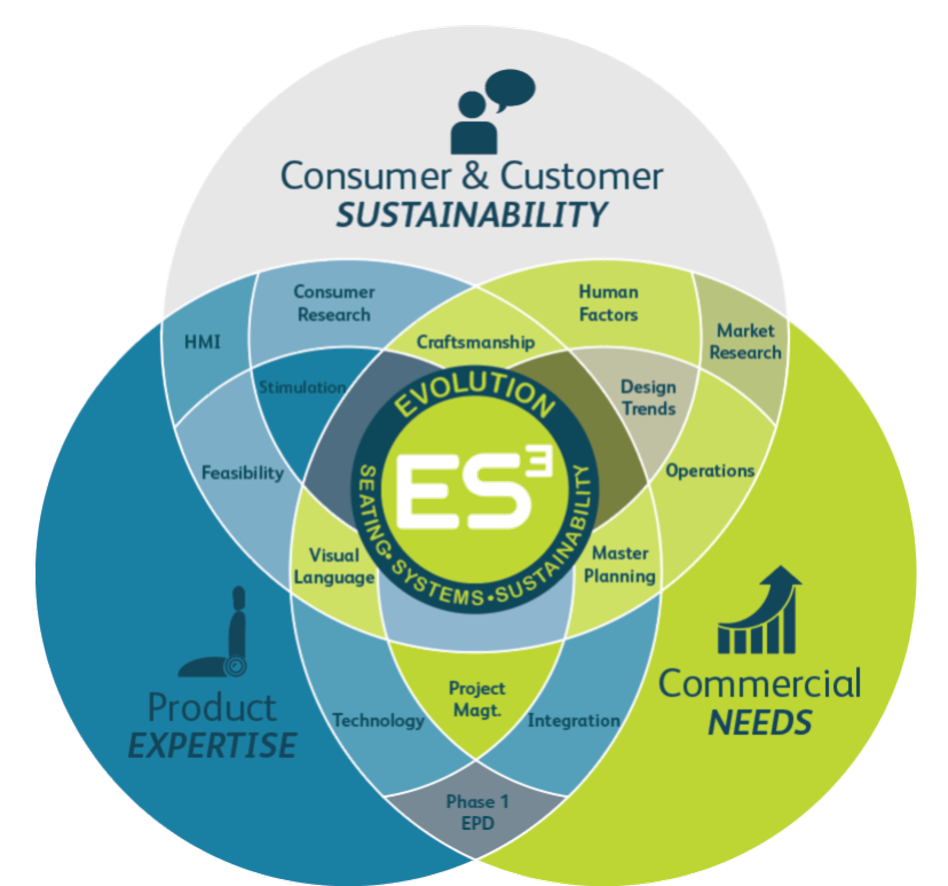
We embed sustainability and circularity into product development using our Evolution of Seating Systems Sustainability (ES³) approach. ES³ integrates market research, value analysis/value engineering (VA/VE), innovation portfolios, benchmarking, quality and safety inputs to reduce design complexity and operational waste while utilizing lower carbon and circular materials — without compromising safety, functionality, comfort, or proven quality.
Life-Cycle Thinking and Product Carbon Footprinting
We evaluate environmental impacts from the early design phase using Adient’s proprietary Product Carbon
Footprint (PCF) Tool and formal life cycle assessment (LCA) practices. The PCF Tool follows International Organization for Standardization (ISO) 14040, ISO 14044 and ISO 14067 standards and World Resources Institute (WRI) guidance; it is used across request for information/request for quotation (RFI/RFQ) programs, product innovation programs, and development programs, and supported by a dedicated Adient team in Trenčín, Slovakia.
Click here to learn more about Adient’s commitment to sustainability.